Saturday, December 13, 2014

Next We Go UP!

Now that the trenches have all been dug for the footings at a depth that will make our house stable on the hillside and through the regular earthquakes that occur, they are filled in and compacted as we mentioned in a previous blog.


Here you can see the dark material that is added with the gravel.


An overview of all the trenches that have been dug.  Although it doesn't look much like a house, we can see where each of the rooms lie and get a better idea of things to come.  After only seeing the plans, it's very exciting!


 All of the work is done by hand with shovels and wheel barrels.  At the end of the day the wheel barrels are turned over for the night waiting to start the process once again in the morning.


This is the compactor  waiting to be put to work!


And here it is being used by one of the workers.


Now that all the compacting and filling is complete, things are about to start moving up!


One last view of the finished fill work.


 Going up starts by laying the  previously created re-bar forms on the bottom of the trench.  It is this base that the vertical structures will be added.


The re-bar forms are set into all of the trenches ready to be secured and used to hold the vertical structures.


Every re-bar from is laid and leveled to make a perfect, secure structure for attaching the vertical forms.


All of the re-bar forms visible here in the rear and right side of the photo are waiting to be included.  The ones already placed where they belong are sitting on small oblong mounds of concrete which help to make everything level and secure.


Here you can see the boards used to traverse the wide trenches by the men, especially if they are pushing a wheel barrel.  The boards that are stuck into the ground with a cross board have string tied to them and these are used for leveling and making sure things are straight.


Making sure every piece of re-bar is positioned perfectly is a team effort.


The amount of re-bar used in this type of construction is huge.  Because Juan Carlos is known for his quality of construction, I'm sure our house will have more than the "norm".


                                                    This man is  cutting the wires used to tie the re-bar together.


This is an overview of the whole project at this juncture.


And the "view" from the other direction!


Little by little the view is changing!


Once the rebar forms are attached with the small metal wires and made secure and level, concrete is poured to hold everything in place.


As you can see things are moving rapidly up.  All of the walls have these structures and the next step will be adding cement blocks and the tubing for electrical, gas and water lines.


Ready for cement blocks! Amazing!


Busy, Busy, Busy!

In the last couple weeks life here has moved into high gear.  With the start of coffee picking season, the holidays and the construction of our house we have been too busy to sit and blog.  A day of picking starts at 4:00 a.m. readying everything to leave the house and gather our pickers and other workers at 6:00 a.m.  As we were short of pickers the first week, I worked and I have a lot of respect for anyone who picks 6 days a week through the season.  I am off today!!  Anyway, we have been finishing picking about 2:30 at which time the coffee goes to the recevedor for measuring and sending to the coop in Palmares.  Hopefully, home by 4:00 p.m., dinner and then bed!

Now to the great strides that have been made on our house.

On a regular basis materials are arriving by large trucks called vagonetas as shown in the photos here.


Heading up the driveway with a load of gravel.


 This truck is delivering a very black sand which is used in making the concrete.


The materials get dumped near the driveway, the only space available on the property.  Hard to believe we have over 9 acres as the building site looks so small and crowded.


This vagoneta is delivering cement blocks.  To me everything seems so heavy, however, the guys working the job pick up the block like they are nothing.


Almost unloaded at the front of the bodega, the cement blocks take up quite a bit of room.  What is amazing is how quickly this pile disappears and becomes part of the walls of our house.


Looking out from the front of the bodega.


One more truck, this time delivering 120# sacks of concrete.    Watching them unload is exhausting and I wonder why they all aren't suffering from severe back problems.  They, however, seem to take the work in stride as just another part of the job.


Here wood, Cypress, has been dropped and stacked.  This wood will be used for forms and where ever wood is required.  We have a number of Cypress trees on our property that are detrimental to the coffee and are thinking of cutting them and having them milled for the wood.  Our Architect/Engineer has said he would buy some which would help us with some costs.


Don is very impressed with the wood and as someone who enjoys working with wood is drooling at the thought of having a pile of his own to create furniture, shelving and just about anything.  Good wood is not as plentiful in Costa Rica and what is available is very expensive.


As I walk to the property I come across a view of our construction site and am a bit taken aback. Until recently, we had no idea how visible we were from quite a distance away on the main road!  It will be interesting to see what it looks like when finished!!


It is once again the season of breathtaking sunsets!  The photos never do them justice but I continue to keep trying! :)


Saturday, November 22, 2014

A Little Further Along! :)


The bodega is complete and at least two workers are living there at this time.  Others arrive by motorcycle or other means of transportation to work on the construction of our house.


Inside is open space with platform beds and a "kitchen" area.  The shower and bathroom areas are in separate buildings. 


Laundry hangs inside when it rains and outside when the weather permits.  Hummmm...just like our house!


A large pole for electricity and life is good!


While creating their "home", work continues on our home. The backhoe moves materials around and digs the holes required for the footings.  The finish work on the footing holes is all done by hand.  Gravel is put in the bottom and compressed with a hand compressor which I will share at the bottom of this blog page. 


As you can see, truckloads of gravel and soil have been delivered along with wood to use for forms.


With little extra room, everything gets piled close together.  Watching everyone work in such limited quarters is amazing.  When we first saw the property graded off it looked huge, however, our opinion of the size of our hilltop has changed dramatically!


Lots of large trenches, created by backbreaking work!  


On the side of the bodega a makeshift assembly line has been created to build the rebar forms required to construct the many columns that will be supporting our roof.  The workers work quickly and smoothly building amazingly uniform structures of different sizes.


These piles are only a small number of the 24 required.  However, I'm sure they will all be completed in just a few more days.  The men working on our house work very long days and often every day.  They are working when Don arrives with Roberto at 6:00 a.m. and they continue until late in the day.  We are not only impressed with the number of hours the men work but also, the quality of work we have observed.  Good for us, as it means our house should move along at a good speed! :)


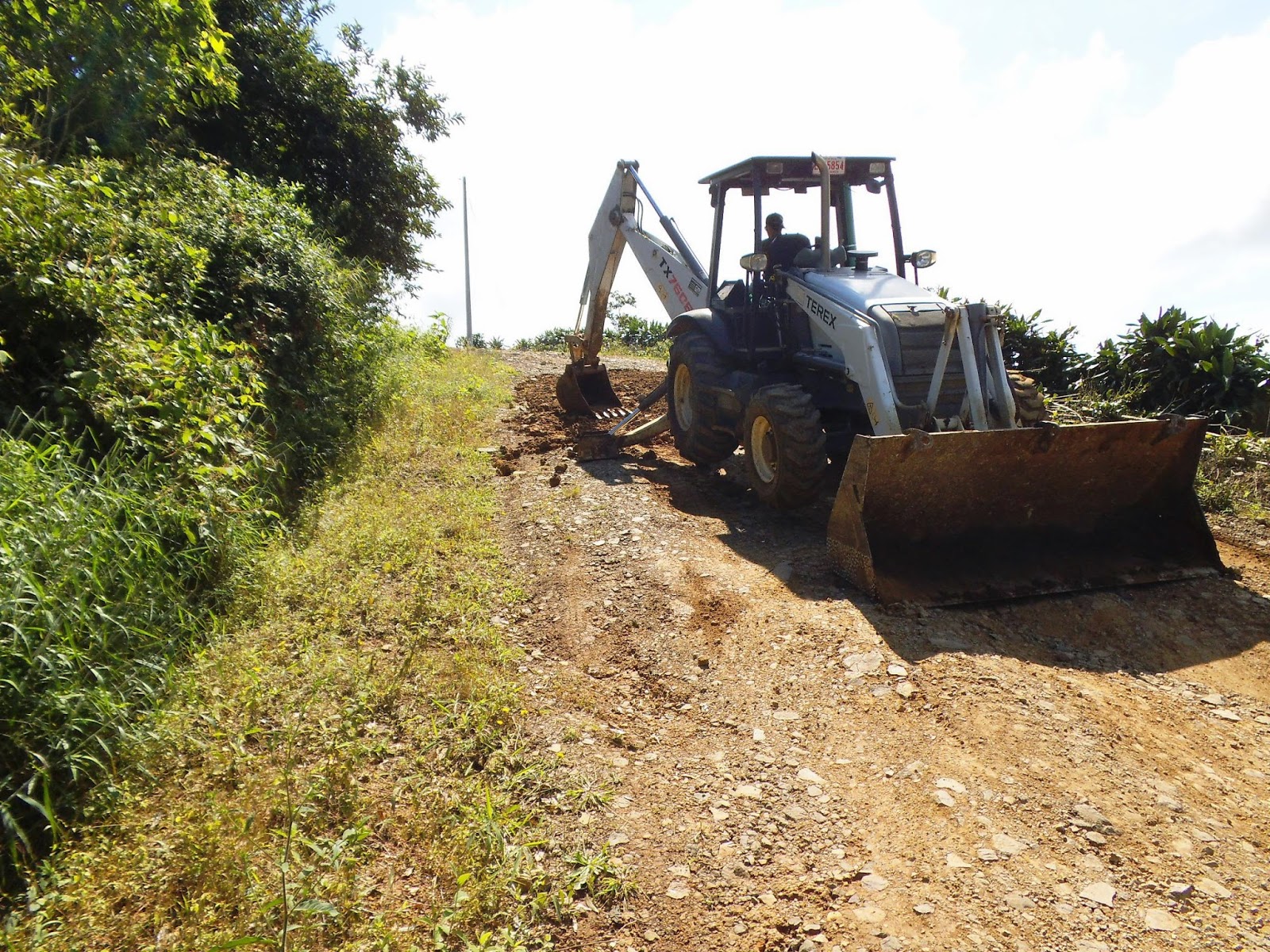
Work is also needed on the road to make our property easier to access.  The backhoe never sits idle and on this day did some work to improve our road while waiting for his next project on site.


Here the road is being broken up and made loose to eliminate the holes that have been created.  Once there is loose gravel and the area is somewhat smoother, the backhoe packs it down.  I am constantly amazed by the talent and abilities of the backhoe owners that have worked for us.


Whoops!  One of the large trucks making deliveries ran over a large water main and caused quite a loss of water and some inconvenience for our neighbors.


Fortunately, repairs were made but the main is still sitting quite close to the edge of the road.


Our septic system is nearly complete.  The man in the photo is creating the concrete top to finish this part of the septic tank.  There are still drain fields to be created and soil to fill in around the sides.


Compacting with a hand compacter!